NBA Props Bets UK: The Complete Player Guide for 2025–26
 Available in US
Table of Contents
- Five Things That Will Define Your Season as a UK NBA Props Bettor
- Why NBA Props Bets Are Reshaping UK Basketball Betting
- What Is an NBA Prop Bet?
- Types of NBA Player Props Available in the UK
- Player Props vs Team Props: What UK Bettors Should Know
- Reading NBA Prop Odds in Decimal Format
- PRA Bets: Points, Rebounds & Assists Combined
- Where to Bet on NBA Props in the UK
- How to Find Value in NBA Player Props
- Same-Game Parlays: Combining NBA Props at UK Bookmakers
- In-Play NBA Props: Betting Live at UK Sites
- Betting Under UKGC Rules: What NBA Prop Bettors Must Know
- Responsible Gambling & Bankroll Management
- The UK NBA Betting Market in Numbers
- Frequently Asked Questions
Five Things That Will Define Your Season as a UK NBA Props Bettor
- NBA prop bets let you wager on individual player stats (points, rebounds, assists, PRA, three-pointers and more) independent of the match result.
- UK bookmakers price these markets in decimal odds; a standard line of 1.909 requires a win rate above 52.4% to be profitable long-term.
- Professionally researched props hit at a 55-58% win rate, per BetNow.eu data; that edge only materialises with structured pre-game research, not intuition.
- Player props represent just 2% of all basketball bets, signalling an underexplored market with real pricing inefficiencies compared to football or tennis.
- The UKGC’s financial vulnerability checks, rolled out nationally in early 2026, trigger at a net deposit of £150 per month. Understand the rules before scaling activity.
Why NBA Props Bets Are Reshaping UK Basketball Betting
Five years ago, I was explaining NBA prop bets to a mate at a Tottenham pub during halftime of a Sunday game, and he looked at me like I was describing advanced particle physics. “So you’re betting on how many points one specific bloke scores? Not whether his team wins?” He thought I was mad. By the end of last season, he was texting me before every Thursday night tip-off asking about PRA lines. That shift, a shift from niche curiosity to genuine mainstream interest, is exactly what has happened to NBA props in the UK, and the numbers back it up in no uncertain terms.
NBA viewership in the UK grew by 40% between 2019 and 2024, with the sharpest rise among viewers under 30, per Sky Sports data. The league’s new broadcasting deal with Amazon Prime Video, signed at the end of 2025, extended that audience further. The O2 London game earlier this season drew more than 18,000 fans – the most-watched NBA Global Game in UK history. People are not just watching the NBA now; they are engaged with individual players in a way that makes proposition betting the most natural extension of that fandom.
What does that translate to at UK bookmakers? More markets, deeper liquidity, and, crucially,more mispriced lines. As the analysts at Action Network put it, NBA prop betting “has exploded over the last few years, partly because it’s a star-driven league. You’re no longer limited to spreads, moneylines and totals – you can creatively bet on almost any outcome in any game through player props and same-game parlays.”
The opportunity is real and specific. Sportradar data shows that player props account for just 2% of all basketball bets placed in the US – a far more mature market than the UK equivalent. In a country where 17.4 million adults placed online bets in 2024, that gap between awareness and penetration is the window where sharp bettors find genuine edge. Lines on a second-tier player’s assist total at a Thursday night game still carry more slack than anything in Premier League football.
This guide covers everything you need to operate in the UK NBA props market during the 2025-26 season: what each prop type means, how decimal odds work for these markets, where to find value, and what the regulatory environment looks like under the current UKGC framework.
What Is an NBA Prop Bet?
The terminology is intuitive once you have the framework, but that framework is worth spelling out precisely: every detail, from what counts toward settlement to which stats go into a PRA total, has a real-money consequence.
A proposition bet, or prop bet, is a wager on a specific statistical outcome that is independent of the final result of the game. In NBA betting, this almost always means a player’s individual performance: how many points they score, how many rebounds they grab, how many assists they contribute, or combinations of all three. The bet settles based on that player’s official box-score line, not on which team wins.
The core mechanic is an over/under structure. The bookmaker sets a line of, say, 22.5 points, and you bet whether a player will go Over or Under that number. Both sides carry odds, and those odds reflect the bookmaker’s assessment of the probability of each outcome. The margin built into both sides, the overround, is how the bookmaker profits regardless of the result.
What makes NBA props particularly interesting from an analytical standpoint is the sheer volume of available markets. A single slate of eight games can produce several hundred individual player prop markets across all major UK-licensed bookmakers. Points lines are the highest-profile, but assists, rebounds, three-pointers made, blocks, steals, turnovers, minutes played, and combined PRA totals are all offered routinely. Some larger operators now include first-basket scorer, double-doubles, and quarter-specific point props on headline games.
Proposition bet (prop bet) – a wager on a specific player’s statistical performance in a single game, settled against a numerical line set by the bookmaker, with the outcome independent of the match result.
Several settlement rules trip people up consistently. First, overtime: in standard UK bookmaker terms, overtime counts toward prop settlement unless the market is explicitly marked “regulation only.” A player who scores 18 in regulation and adds 7 in OT has settled your Over 24.5 as a winner. Second, player participation: if a player does not play, most UK bookmakers void the bet and return your stake. What happens if he plays one minute then exits is operator-specific. Third, lines move in response to injury news and market forces right up to tip-off. All three of these details have real-money consequences; checking them before you place is not optional.
The appeal of props is structural. A player’s statistical performance is driven by identifiable, researchable variables: usage rate, minutes allocation, matchup against a specific defensive scheme, game pace, teammate injury status, and the likely game script. These variables are not priced with equal efficiency by UK bookmakers across all markets, particularly for non-marquee players in midweek games. The inefficiency: the gap between the bookmaker’s implied probability and the true probability. Thatis where the edge lives.
Types of NBA Player Props Available in the UK
The first time I looked at a full NBA props slate at a UK bookmaker, I expected maybe fifteen markets per game. What I found was closer to forty, and that was before same-game parlay builders started combining them. The breadth of what is available has expanded sharply over the past two seasons. Here is what you will actually encounter. Here is what each market requires you to understand before you bet it.
Points Props
The most liquid NBA prop market. The bookmaker sets a points total in increments of 0.5 and you bet Over or Under. Lines are tight for star players but secondary scorers on midweek games frequently show gaps, especially when lineup news moves usage.
Rebounds Props
Driven by a player’s positional role, their team’s rebounding scheme, and the opponent’s offensive rebound rate. Because rebounds get less public attention than points, lines are often less sharp. Front-court players in high-pace games benefit from volume that bookmakers do not always fully price in.
Assists Props
Correlate strongly with usage rate and the availability of primary finishers. Late injury news on a player who draws significant plays from the guard creates an immediate assists line opportunity; act quickly, as these lines move fast once the information is public.
Three-Pointers Made (3PM)
High-variance, high-reward. A 37% shooter taking six attempts per game will hit Over 1.5 threes far less than half the time; the tails are unforgiving. Matchup data matters: shooters facing bottom-five defences against the three see genuine benefits that lines on non-marquee games do not always fully capture.
Blocks and Steals
The smallest markets by volume and often the most mispriced. Blocks correlate tightly with a defender’s positioning style and the opponent’s interior shot profile. These markets receive less pricing scrutiny, and lines can be meaningfully off when specific matchup context is applied.
PRA (Points, Rebounds and Assists)
The combined line rolls three stats into one total, available on all major UK sites for primary players and increasingly for secondary contributors. The market suits high-usage versatile players. A detailed breakdown of PRA pricing and where bookmakers lag is in the NBA player props explained guide.
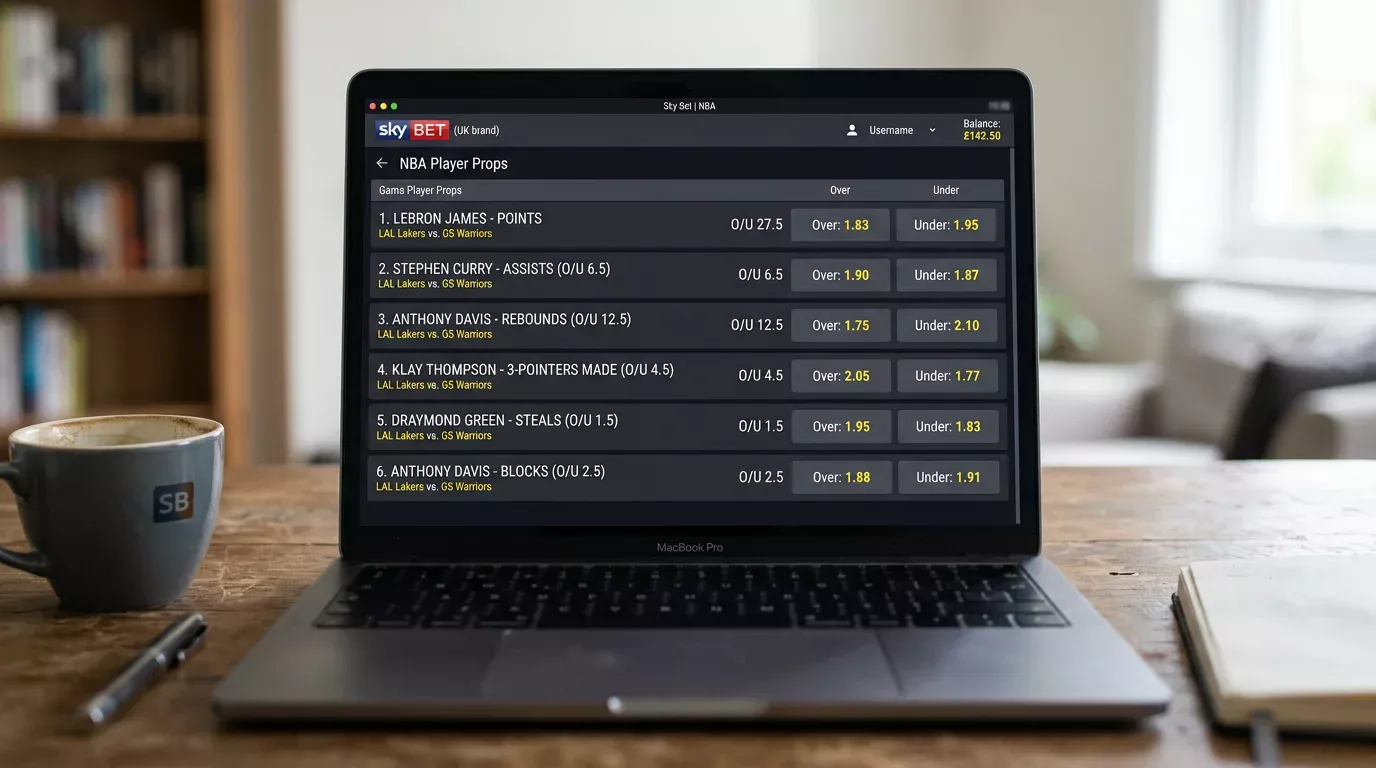
Beyond these six core types, larger UK operators offer double-doubles, first-basket scorer, and points-in-a-quarter props on headline games. The further you go from standard points totals, the less precisely lines are priced: more potential edge, but also thinner markets that are harder to get meaningful stakes into at decent odds. Points and rebounds props on rotation players shaped by late lineup news remain where the softest pricing consistently appears.
Player Props vs Team Props: What UK Bettors Should Know
I made this mistake in my second year seriously betting NBA props: I treated team total markets (first-quarter over/unders, team points totals) as the same analytical exercise as player props. They are not. The underlying variables differ, the research process differs, and the pricing efficiency differs substantially.
Player props are bets on individual performance. The research inputs are player-level: minutes allocation, usage rate, historical performance in similar matchup contexts, injury report for both the player and key teammates, specific defensive assignment from the opponent. Your edge comes from knowing something about this specific player’s role in this specific game that is not fully reflected in the bookmaker’s current line.
Team props are bets on collective outcomes. First-quarter points totals, team total points: these require modelling game flow, pace, defensive scheme, and roster interaction effects. You are estimating how two entire rosters will perform in combination, not how one player within a system will respond to a specific context. The information set is broader and the edges correspondingly harder to isolate with precision.
The practical consequence is pricing efficiency. Team props at UK bookmakers are more efficiently priced because a larger pool of bettors, including football bettors who cross over to NBA with strong team-level intuition,compresses the margins. Player props for non-star contributors on midweek games are comparatively under-researched by the UK betting public. The lines reflect it, and that is the current reality in 2026 as NBA props penetration grows from a small base.
The test I use: if my pre-game notes are mostly about team schemes and matchup tendencies rather than individual player role, usage, and lineup context, I am in team prop territory. Both can be profitable, but they require different research processes. Build the right one around the market you are actually operating in.
Reading NBA Prop Odds in Decimal Format
The single biggest friction point when US-facing NBA content reaches UK readers is the odds format. American sports coverage lives in the +150 and -110 world. UK bookmakers quote decimal odds. They describe the same probabilities, but the translation is not obvious on the fly, and getting it wrong mid-research is the kind of small error that distorts your entire value assessment.
Decimal odds represent your total return per unit staked, including the return of your original stake. Odds of 2.00 mean you receive £2.00 for every £1.00 staked: that is your £1 back plus £1 profit. Odds of 1.909 mean you receive £1.909 per £1 staked,£0.909 in profit. The single most important number for a props bettor is the implied probability, which you calculate by dividing 1 by the decimal odds. At 1.909, the implied probability is 52.4%. That is your break-even point; you need to win more than 52.4% of those bets to profit long-term.
Decimal Odds in Practice: Points Prop
Suppose a player’s Over 22.5 points is priced at 1.870, Under at 1.952.
Implied probability (Over): 1 ÷ 1.870 = 53.5%
Implied probability (Under): 1 ÷ 1.952 = 51.2%
Combined implied probability: 104.7%: the bookmaker’s margin is 4.7%.
The asymmetry tells you the market favours the Over; the bookmaker has shaded the line toward the Under side to balance action, or sharp money has moved the Over price.
Break-even if you bet the Over: win more than 53.5% of similar bets. If your research indicates a 59% true probability of the Over, this is a positive-EV position.
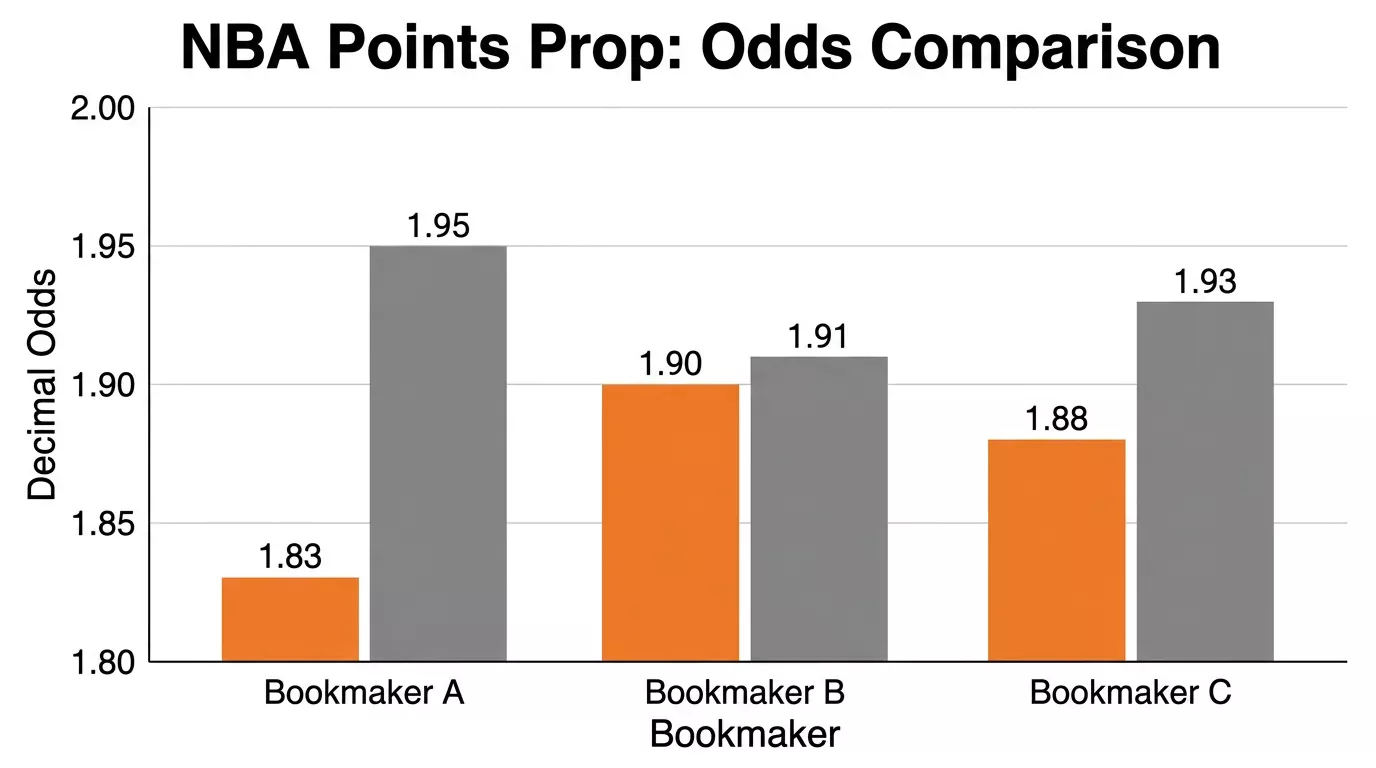
The overround, i.e. the excess implied probability above 100%,is the bookmaker’s structural edge. On a symmetric line where both sides pay 1.909, the overround is 4.8%. On a market with meaningful asymmetry (one side at 1.800, the other at 2.100)the total implied probability rises above 110%, increasing the bookmaker’s margin and raising your break-even threshold on the short-priced side. Wider overrounds appear more frequently in secondary markets and on lower-profile games. Always calculate the overround before assessing whether a bet has genuine value.
For UK bettors cross-referencing American analytical content, the conversion is simple. A positive American line such as +120 converts to decimal as (100 ÷ 220) + 1 = 1.833. A negative line such as -130 converts as (130 ÷ 230) + 1 = 1.769. This is primarily useful when assessing whether the UK decimal price represents value against a US-based model; US sportsbook lines and UK bookmaker lines on the same prop can differ, and that gap occasionally represents an exploitable inefficiency.
PRA Bets: Points, Rebounds & Assists Combined
PRA is the market where I find the most consistently mispriced lines, particularly for versatile forwards and high-usage bigs who contribute across all three columns. PRA stands for Points + Rebounds + Assists: a player who finishes with 21 points, 7 rebounds and 4 assists has a PRA of 32. The bookmaker sets a line on this combined figure in the same over/under structure as any other prop, available at all major UK sites for primary players and increasingly for secondary contributors on high-profile games.
The structural nuance that creates edge: the three components are correlated. A player having a high-usage game scores more, generates more assist opportunities, and stays on the floor longer for more rebounding chances. A high-pace game inflates possessions and tends to boost all three columns simultaneously. Betting a PRA line is taking a position on whether the overall game context is conducive to high-volume individual contribution: a more stable prediction than forecasting a specific points total.
PRA Line Assessment: Step-by-Step
Step 1 – Establish the baseline. A versatile forward has a season PRA average of 30.3 (18.4 pts, 7.1 reb, 4.8 ast). The bookmaker’s line is 36.5. The line is 6.2 above his average; that is significant.
Step 2 – Check lineup context. His primary ball-handler is listed as questionable with a knee issue. Historical splits show this player’s PRA averages 34.7 when that starter is absent. Still below 36.5, but the gap has narrowed.
Step 3 – Assess the matchup. Tonight’s opponent ranks 28th in defensive rating. In games against bottom-five defences this season, his PRA averages 38.2. The matchup variable moves this meaningfully toward the Over.
Step 4 – Factor in pace. The opponent runs the fourth-fastest pace in the league. More possessions mean more opportunities across all three columns. His per-36 PRA in pace-up games sits at 41.1.
Step 5 – Calculate value. Over 36.5 is priced at 1.952 – implied probability 51.2%. Given the matchup and pace context, the assessed true probability of the Over is approximately 58%. That is a positive-EV bet worth placing.
The worked example shows why PRA research rewards the analyst who works through multiple variables. The season average is the starting point, not the conclusion. Game context – pace, matchup quality, lineup-adjusted usage – consistently moves the true probability enough to create gaps against the bookmaker’s implied odds, especially on games that receive less market attention.
Where to Bet on NBA Props in the UK
This is the question I am asked most often, and the honest answer is: the right bookmaker for NBA props depends on what you are trying to accomplish. No single site dominates every market, every game, every night. The UK online gambling sector generated £7.8 billion in GGY during 2024-25, growing 13.1% year on year, and competition between UKGC-licensed operators has pushed NBA prop market quality meaningfully upward. That competitive pressure is your ally as a bettor.
All UK bookmakers offering NBA props operate under a UKGC licence: player funds protection, responsible gambling tools, independent dispute resolution, and oversight under the Gambling Act 2005. When a settlement dispute arises over a voided prop or an overtime inclusion, you have a genuine complaints and arbitration process available. The licensed market is where serious UK props bettors should operate, full stop.
Market Depth
The breadth of prop markets varies significantly between bookmakers. Larger licensed operators offer points, rebounds, assists, 3PM, blocks, steals and PRA for major games, plus same-game parlay builders. Smaller operators may only carry points lines for top players on headline games. A bookmaker with 60 markets on a Sunday night showpiece may offer only 8 on a Tuesday night back-to-back. Check availability before committing to a primary site.
Odds Quality
The overround on NBA props varies noticeably between UK bookmakers. A line priced at 1.952 at one operator versus 1.870 at another on the same market is a 4% swing in implied probability. Over a season of regular betting, that differential compounds into a material impact on returns. Maintaining accounts at multiple UKGC-licensed operators for line-shopping is not optional if you are serious about long-term profitability.
Bet Builder Features
Same-game parlay functionality, known as Bet Builder at most UK operators, is increasingly central to NBA props betting. Not all bookmakers permit all combinations, the correlation discounts applied differ, and the available markets vary. Test your preferred combinations before a high-stakes game, not during one.
For a current-season comparison of which UK-licensed bookmakers offer the deepest NBA prop markets, how their Bet Builder tools differ, and what odds quality looks like across market types, the UK bookmakers NBA props guide covers exactly that ground.
On account management: UK bookmakers can restrict winning accounts – reducing maximum stakes when a customer shows consistent positive ROI. The mitigation is maintaining accounts at multiple licensed operators simultaneously and rotating activity to avoid signalling systematic edge to any single bookmaker too early.
How to Find Value in NBA Player Props
Value in props comes from structured, repeatable, disciplined research. The process I use has evolved over a decade, but the core framework has not changed: estimate the true probability of an outcome more accurately than the bookmaker, and only bet when that estimate generates positive expected value. Everything else is noise.
Professionally researched NBA player props hit at a 55-58% win rate, against the 52.4% break-even rate required at odds of 1.909, per BetNow.eu analysis. That gap is not enormous, but at 55% across 200 bets per season at £25 each, the mathematics produce a profitable season. At 48% with no research, the same volume produces consistent losses. The research process is the entire difference.
Pre-Game NBA Props Research Checklist
- Injury report: is your target player confirmed active? Are key teammates out or questionable?
- Lineup-adjusted usage: if a primary teammate is absent, how does this player’s historical usage rate shift?
- Defensive matchup: what is the opponent’s defensive rating? How do they defend this player’s specific skill set?
- Game pace: is this opponent fast-paced? More possessions inflate stat ceilings across all categories.
- Schedule: is this a back-to-back game? Second-night performances show measurable declines for rotation players.
- Line shopping: check at least two other licensed operators before placing.
- Implied probability: does your assessed true probability beat the bookmaker’s implied odds by a meaningful margin after overround?
The matchup variable is the one I see bettors underweight most consistently. As Elijah Jackson, NBA analyst at sportsgambler.com, put it: “Our NBA player analysis focuses on usage, minutes distribution and matchup context rather than headline box-score stats. We assess how rotation factors, injury absences, game pace and defensive assignments impact a player’s role in a specific game.” That last phrase: a specific game, not the season average. Thatis the key. Season averages are the market’s starting point; game-specific context is where you deviate from them to find the edge.
Break-Even Win Rate
52.4% at odds of 1.909. The minimum required to avoid long-term losses on a standard even-money props line.
Researched Win Rate
55-58% for professionally researched player props (BetNow.eu, 2025). The edge is real but requires genuine process.
Where Lines Are Softest
Secondary players on midweek games; late injury news affecting usage; rotation-dependent props in pace-up matchups.
Two Mistakes That Kill Edge
Anchoring to season averages without game-context adjustment; following line movement without knowing why the line moved.

This follows the five-step props workflow: start from the season average, adjust for lineup-driven usage, the defensive matchup, pace and the back-to-back schedule, then compare your projection to the line. Season averages are the market’s starting point — game context is where you deviate to find edge. The projection is a structured estimate, not a guarantee; PRA and rebounds on midweek games are where lines are softest. Informational only.
Even a genuine 55% bettor loses 45% of the time — an eight-to-ten-bet losing run is normal, not a sign the edge is gone. A properly sized bank (most props bettors risk 1–3% per bet) survives those runs; an oversized stake does not. The break-even at 1.909 is 52.4%: below it, no staking plan wins long-term. The correct response to a losing streak is to review your research process, never to raise stakes to chase it back. Informational only.
The analytical framework behind finding consistent edge. It covers the full EV calculation methodology and how to build a research workflow across the NBA calendar – is covered in the NBA prop betting strategy guide. This section gives you the framework; that guide gives you the full process for implementing it systematically over a season.
Same-Game Parlays: Combining NBA Props at UK Bookmakers
The first time I won a same-game parlay, I was briefly convinced I had found a money printer. The second time I properly modelled the expected value of a similar combination, I understood why they are simultaneously exciting and structurally dangerous. Same-game parlays (known in the UK as Bet Builders) combine multiple props from the same game into a single bet at multiplied odds. Done correctly, with a proper understanding of correlation, they are a legitimate tool. Done carelessly, they are among the more effective ways bookmakers extract margin from bettors who have not done the maths.
A same-game parlay (SGP) combines two or more selections from the same NBA game into a single wager at multiplied odds. Because selections come from the same game, their outcomes are correlated – a high-scoring, fast-paced game tends to benefit multiple players’ stat lines simultaneously. UK bookmakers apply a “correlation discount” that reduces the payout below what an independent parlay would offer. The skill is identifying combinations where the correlation in your favour is larger than the discount applied.
The practical application: if you assess a game as likely to be high-pace against a weak defence, you might combine a primary scorer’s Over points line with a playmaker’s Over assists line and perhaps the team total Over. These outcomes move together – a fast, high-scoring game benefits all three simultaneously. The bookmaker applies a correlation discount based on average correlations; the edge opportunity exists when you are assessing a specific game context where the correlation is stronger than their model assumes.
Where SGPs break down: internally contradictory combinations. Betting a player’s points Over alongside their minutes Under is a logical contradiction: they cannot score enough to hit the Over without the minutes. Combining two players’ scoring Overs in a game you expect to be low-scoring because you like the total Under is a position that argues against itself. No correlation discount can save a combination that is structurally incoherent.
UK bookmakers vary meaningfully in how they price NBA same-game parlays. Some apply static correlation discounts; others use dynamic pricing that responds to market movement. For a complete guide to building SGPs with NBA props at UK bookmakers – including which combinations offer the most favourable structural value and how to identify the best pricing across operators – see the same-game parlay guide.
Start with two-leg combinations if you are new to SGPs. Compounding overrounds and correlation discounts in a three- or four-leg SGP requires strong edge on every individual leg to generate positive expected value. Two-leg combinations are easier to model and easier to evaluate in retrospect.
In-Play NBA Props: Betting Live at UK Sites
Live props are the hardest NBA market to beat systematically; it is also one of the most intellectually interesting. The speed at which lines move in-game means informational advantages evaporate within seconds. But when you are watching a game and spot something the bookmaker’s algorithm has not fully processed, the opportunity is real, immediate, and time-limited in exactly the kind of way that sharpens decision-making.
17.4 million UK adults placed online bets in 2024 – roughly one in three of the adult population – and in-play betting now accounts for the majority of stakes at most major UK licensed operators. The NBA generates particularly active in-play markets because possessions change every 15-20 seconds, and each carries implications for player stat totals.
The most exploitable in-play situations in NBA props involve foul trouble and late scratches. When a star player picks up two fouls in the first quarter and sits out a significant stretch of the second, their points line does not always adjust immediately, particularly at operators with slower live pricing architecture. In that window, the Under on their points prop represents genuine value. Similarly, when a key teammate exits injured in the first few minutes, usage redistributes to secondary players whose live stat lines frequently lag behind the new reality.
The mechanics of live props at UK bookmakers vary more than pre-game markets. Some operators suspend all live props during free throws, timeouts, and video review stoppages; others maintain near-continuous pricing. Getting familiar with how your specific bookmakers handle live NBA markets – when they suspend, how quickly they reprice – is operational knowledge that meaningfully affects your ability to act in the right windows.
For a systematic breakdown of live NBA prop betting at UK sites – including which game situations create the most consistent pricing lag and how to integrate in-play data with your pre-game model – the NBA live props guide covers the full methodology.
Betting Under UKGC Rules: What NBA Prop Bettors Must Know
The regulatory changes that came into force over the past eighteen months directly affect how any serious UK bettor manages their activity. The UKGC has moved decisively in 2025-26 to strengthen consumer protections, and while most headline changes target problem gambling, several have concrete operational implications for bettors working at consistent, meaningful volumes.
The most significant development for active bettors is the financial vulnerability check system. From 28 February 2025, all UKGC-licensed operators are required to trigger a check when a customer’s net deposits reach £150 in any calendar month. In Q1 2026, this moved to a full national rollout across the entire licensed market. The check draws on open banking data and credit reference agency information to assess whether a customer may be experiencing financial harm. The UKGC’s own pilot data showed that 95% of checks were completed without any friction for the player; for most people operating within normal financial parameters, the process runs invisibly in the background.
Understanding the £150 monthly trigger: the check activates based on net deposits: money deposited minus money withdrawn. Deposit £200 and withdraw £80, your net for the month is £120 – below the threshold. Regular withdrawals as part of disciplined bankroll management effectively manage your net deposit position. Keeping records of all deposits and withdrawals is both good practice for your own P&L tracking and useful context if a check is ever triggered.
From April 2025, a statutory gambling levy came into effect, requiring all UKGC-licensed operators to contribute to addiction treatment funding. The broader regulatory framework requires self-exclusion through GamStop, mandatory deposit limits and reality checks, and dispute resolution through independent arbitration. If you have a dispute over prop settlement – overtime inclusion, player participation, or market terms – you have access to a genuine adjudication process. That backstop does not exist with unlicensed operators. The Gambling Commission estimates around 2.1 million UK adults regularly used unlicensed operators in Q4 2024; the UKGC issued 741 cease-and-desist notices to illegal sites in 2025-26. For NBA props – where settlement disputes over participation rules and overtime are not uncommon – the value of regulated recourse is concrete.
Responsible Gambling & Bankroll Management
The single most important paragraph in this entire guide is this one: fewer than 5% of sports bettors are consistently profitable in the long run. That figure, drawn from SportBot AI’s 2026 research across multiple betting markets, is not intended to discourage informed, enjoyable betting. It is intended to calibrate expectations honestly and to prompt the kind of bankroll discipline that separates sustainable bettors – the small percentage who turn research into returns – from those who chase losses into genuine financial harm.
Bankroll basics: allocate a dedicated betting bank from money you can afford to lose in full without affecting your financial life. Most experienced props bettors risk between 1% and 3% of their total bank per bet. On a £500 bank, that is £5-15 per bet. This sounds conservative, but variance in prop betting is real and harsh – even a 55% win-rate bettor will experience runs of eight to ten consecutive losses. A properly sized bank survives those runs intact. An improperly sized one does not.
Variance is the concept most recreational bettors underestimate. A bet with a genuine 55% win probability will lose 45% of the time. Over 20 bets, even a positively-expected bettor will experience stretches that feel like the edge has disappeared. The correct response to a losing streak is to review whether your research process is still functioning as intended – not to increase bet sizes to recover losses faster. That second instinct is the mechanism by which the “fewer than 5% are profitable” statistic perpetuates itself.
The UKGC’s responsible gambling framework requires all licensed operators to offer deposit limits, cooling-off periods, and self-exclusion tools. Use them proactively – before a difficult stretch begins, not after. GamStop provides national self-exclusion if betting stops being recreational. BeGambleAware at begambleaware.org offers independent support and resources.
Treat your prop betting as any other analytical activity: track every bet, record your reasoning at the time of placing, and review outcomes quarterly. The data will tell you honestly whether your research process is generating real edge or whether you have been confusing a favourable variance run with skill. The research discipline and the bankroll discipline reinforce each other – build both together from the start.
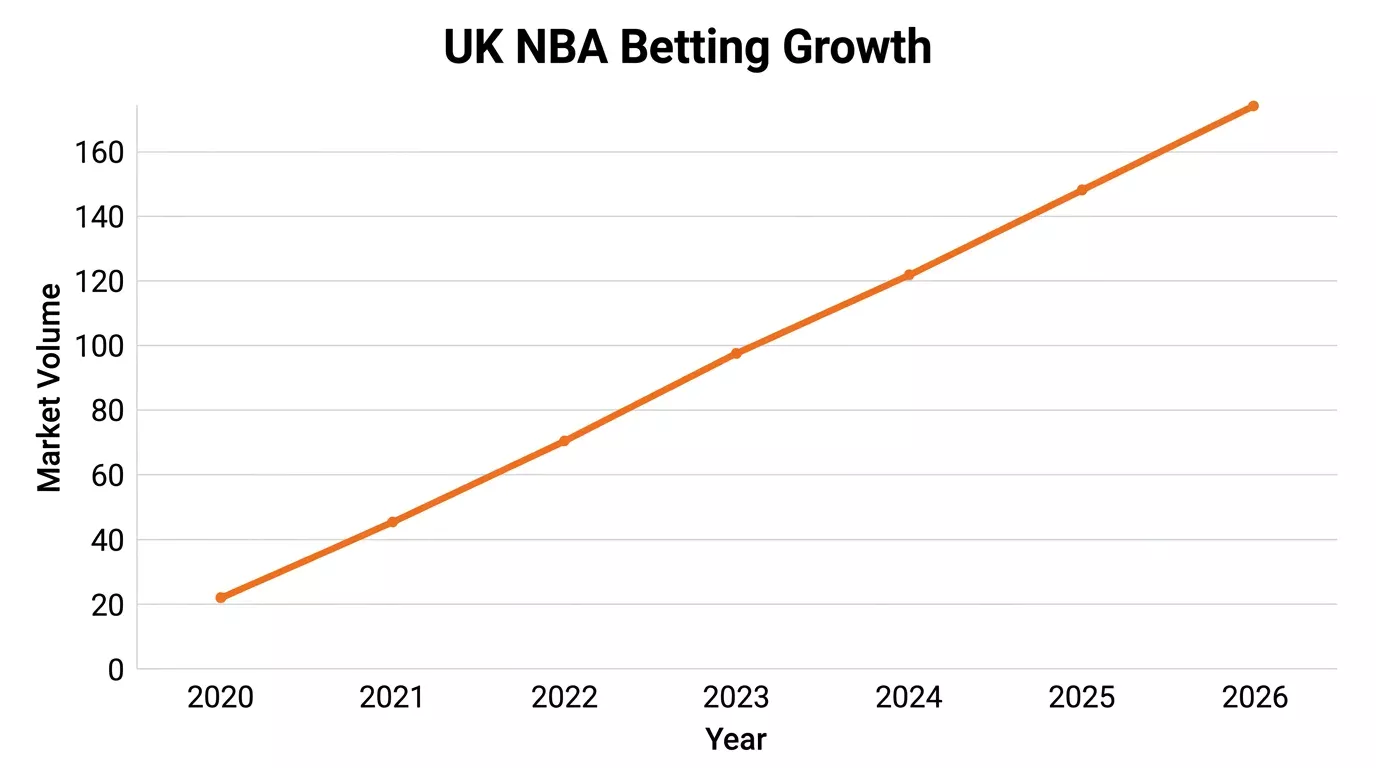
The UK NBA Betting Market in Numbers
There is a particular early-adopter advantage available to UK NBA props bettors right now. The numbers point to a segment growing rapidly from a very small base, which is historically the precise moment when pricing inefficiencies run deepest and competition for edge is thinnest.
Global Basketball Betting Market
$28 billion in 2023, forecast to grow at 9.12% CAGR through 2030 (Bosson Research). Basketball is among the fastest-growing sports betting markets globally.
UK Online Gambling GGY
£16.8 billion in financial year 2024-25, up 7.3% year on year (Gambling Commission). The online segment grew 13.1% to £7.8bn – the fastest-growing component of the market.
NBA Viewership in the UK
+40% between 2019 and 2024 (Sky Sports). The Amazon Prime Video broadcast deal at the end of 2025 further extended the UK audience significantly.
Player Props Penetration
Just 2% of all basketball bets are currently player props globally (Sportradar, 2024). In the UK, where the market is newer, penetration is even lower. This is the fundamental opportunity signal.
Sportradar’s analysts framed the structural opportunity directly: “40% of Gen Z adults have a favourite NBA player – the highest across major leagues – while player props account for just 2% of basketball bets, indicating significant growth potential.” That gap between individual player fandom and individual player betting is the macro-level market inefficiency. At the micro level, it means UK bookmakers are pricing NBA props with generalist models rather than specialist analytics: exactly the environment that rewards the bettor who does genuine pre-game research.
In UK football betting, you compete against millions of well-informed fellow bettors and bookmakers with decades of club-specific data. In NBA player props in the UK, the competition pool is smaller, the data infrastructure among the general public is less developed, and the bookmakers are adapting models built for more mature US sportsbook contexts. That structural advantage will narrow as the market matures (it always does),but in 2026 the window is open. The bettors building expertise and research processes now are positioning themselves well ahead of when this market reaches the same pricing efficiency as football.
Frequently Asked Questions
What is an NBA prop bet and how does it differ from a match result wager?
An NBA prop bet is a wager on a specific player’s statistical performance in a single game, settled on their individual box-score line rather than the game’s final result. A match result wager depends on team-level outcomes. A prop bet is entirely determined by what one player does, independent of whether their team wins or loses. You can win a points prop on a player whose team loses, as long as they reached their statistical line before the final buzzer.
How do NBA player props work at UK bookmakers like Bet365 and Betway?
UK bookmakers list NBA player props as over/under markets: the bookmaker sets a line – for example, 22.5 points – and you bet whether the player will go Over or Under that total in the game. Both sides are priced in decimal odds. Lines update as tip-off approaches, reflecting injury news and market forces. Settlement uses official box-score statistics. If the player does not participate, most UK bookmakers void the bet and return the stake – check the specific market terms, as rules around partial participation and suspended games vary between operators.
What does PRA mean in NBA betting?
PRA stands for Points + Rebounds + Assists. It is a combined market that adds all three of a player’s core statistical totals into a single number, with you betting Over or Under the bookmaker’s set line. A player with 20 points, 8 rebounds and 5 assists has a PRA of 33. The market suits versatile players who contribute across all three categories and tends to show slightly more pricing inefficiency than individual stat lines, particularly for secondary players in games that receive less bookmaker attention.
Does overtime count in NBA prop bets?
Yes – in standard UK bookmaker terms, overtime counts toward prop settlement unless the market is explicitly labelled “regulation only.” A player who scores 18 in regulation and 7 in an overtime period has a final total of 25 for settlement purposes. This is particularly relevant when a game enters overtime late and you are assessing whether a bet has already been won or lost. Always check the individual market terms before placing, as some operators apply different rules to specific prop types.
Which types of NBA props are most popular with UK bettors?
Points props are by far the most traded market – intuitive for bettors coming from football, where goal-scoring is the primary individual market. Rebounds and assists props have grown as UK NBA analytics literacy has expanded. PRA combined lines are popular with experienced bettors because they reduce single-stat variance. Three-pointers made props attract action for their high-variance, high-payout profile, though they require careful matchup research to approach with genuine edge rather than speculation.
How should I use the NBA injury report before placing prop bets?
The final official injury update is due roughly an hour before tip-off. The most actionable window is the 30-60 minutes before tip-off, when questionable players are confirmed in or out. When a key teammate is ruled out and the bookmaker is slow to adjust the usage beneficiaries’ lines, there is a genuine short-term pricing gap. Have your accounts funded and target markets identified before the window opens – spending that time setting up means missing the opportunity.
What is a same-game parlay and can I combine NBA props at UK bookmakers?
A same-game parlay, known as Bet Builder at most UK operators, combines two or more selections from the same NBA game into a single bet at multiplied odds. Yes, you can combine NBA player props within a Bet Builder at major UK-licensed bookmakers. UK bookmakers apply a correlation discount to SGP odds because outcomes from the same game are not independent. Positive-EV same-game parlays require identifying combinations where the true correlation in your favour is stronger than the discount the bookmaker has applied.
Created by the ”nba Props Bets” editorial team.